
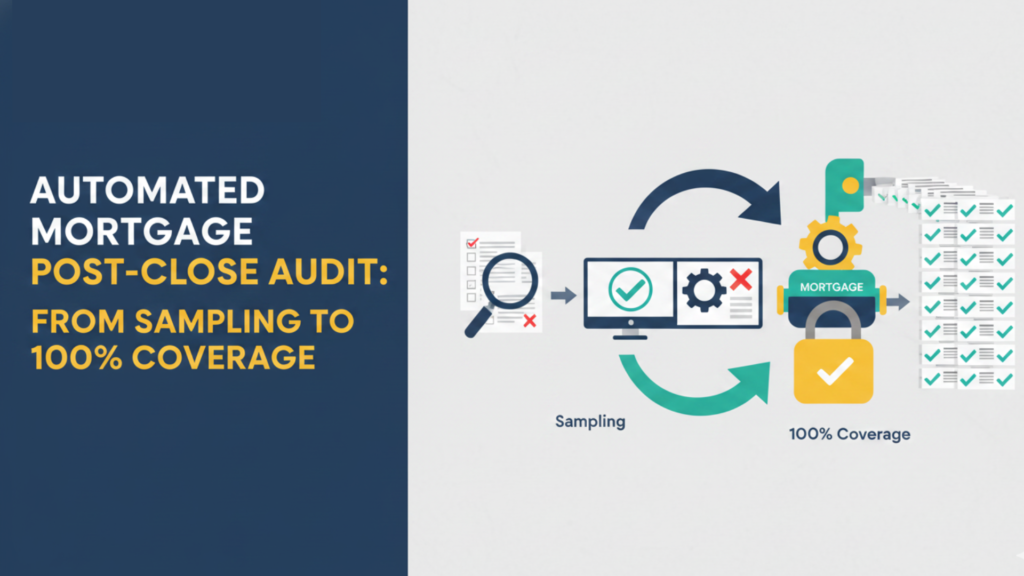

Post-close quality control has traditionally relied on sampling. A subset of loans is reviewed after closing, findings are documented, and trends are addressed over time. That model assumes risk is evenly distributed across files.
In practice, risk is not evenly distributed. A single defect in an unreviewed file can trigger repurchase demands, investor disputes, or compliance exposure. Sampling leaves gaps.
An automated mortgage post-close audit replaces that model with full-loan coverage. Instead of reviewing a fraction of production, lenders can evaluate every closed loan using structured, rules-based and AI-driven systems.
This shift changes post-close from retrospective review to active risk control.
Why Post-Close Sampling Is a Liability
Sampling was built for operational constraints. Manual review takes time, and reviewing every loan was not feasible at scale. Technology removes that constraint.
The problem with sampling:
- Only a percentage of loans are reviewed
- Defects in unreviewed files remain undetected
- Trends are identified after risk has already materialized
A 10% sample does not reduce 90% of risk. It only provides partial visibility.
An automated mortgage post-close audit eliminates this limitation by applying consistent review standards across the full population.
AI Enables 100% Coverage at Scale
Advances in AI-powered loan processing allow systems to:
- Extract and validate data from documents
- Cross-check loan files against regulatory requirements
- Identify inconsistencies across datasets
This enables real-time mortgage compliance monitoring across all closed loans, not just a subset.
The result is a scalable model where coverage increases without increasing headcount.
The Limits of Manual Post-Close Audits
Manual audits introduce variability and delay. Even well-trained teams face structural limitations.
1. Sampling Leaves Most Risk Untested
A typical audit reviews 5–10% of loans. That means:
- 90–95% of files are not reviewed
- Defects in those files remain latent
This creates exposure that surfaces later through investor reviews or repurchase demands.
2. Human Variability
Manual reviews depend on:
- Individual interpretation
- Reviewer experience
- Time constraints
This leads to inconsistent findings across similar files.
3. Delayed Feedback Loops
Manual audits often occur weeks after closing.
By the time issues are identified:
- Loans may already be sold
- Corrections become costly or impossible
4. Repurchase Demand Exposure
Data defects, income miscalculations, missing documentation, or misapplied guidelines, can trigger repurchase requests.
Without full coverage, these risks remain undetected until external review.
An automated mortgage post-close audit addresses these limitations by standardizing and scaling the review process.
What Automated Post-Close Audit Covers
Automation expands both the scope and depth of review.
1. TRID Analysis
Systems validate:
- Disclosure timing
- Fee tolerances
- Compliance with regulatory thresholds
This reduces compliance risk tied to disclosure violations.
2. URLA Data Validation
Loan application data is cross-checked against:
- Supporting documents
- Income calculations
- Asset verification
This helps improve mortgage loan data accuracy across files.
3. Document Indexing and Classification
Automated systems:
- Identify document types
- Extract relevant data fields
- Organize files consistently
This eliminates manual indexing and reduces processing time.
4. Variance Reporting
The system flags:
- Data mismatches
- Missing fields
- Calculation discrepancies
These variances are documented systematically, supporting faster resolution.
5. Underwriting Conditions Review
Automation verifies:
- Conditions were satisfied
- Required documentation is present
- Exceptions are documented correctly
This reduces reliance on manual condition tracking and helps eliminate manual underwriting bottlenecks.
6. Clearing Verification
The system confirms that:
- All required conditions are cleared
- Supporting documentation aligns with decisions
This ensures consistency between underwriting decisions and final file contents.
Cure-Then-Ship vs. Ship-Then-Hope
Traditional workflows often follow a “ship-then-hope” model:
- Loans are closed and sold
- Issues are discovered later
This introduces downstream risk.
Cure-Then-Ship Model
An automated mortgage post-close audit supports a “cure-then-ship” approach:
- All loans are reviewed before sale
- Defects are identified early
- Corrections are completed proactively
Impact on Secondary Market Performance
This approach improves:
- Investor confidence
- Pricing consistency
- Delivery timelines
Reducing defects before sale lowers repurchase risk and strengthens relationships with investors.
Speed and Scale
Automation changes both speed and capacity.
1. Faster Turnaround
Automated systems can:
- Review files within one business day
- Deliver structured findings quickly
This accelerates decision-making and issue resolution.
2. Scalable Operations
As loan volume increases:
- Processing capacity scales without proportional staffing increases
- Review consistency remains stable
3. LOS Integration
Results can be:
- Posted directly into loan origination systems
- Integrated into existing workflows
This reduces manual data transfer and improves visibility.
TechMor’s Post-Close Audit Approach
Providers like TechMor Services apply automation to full-loan review models.
Key capabilities:
- 100% Due Diligence Coverage
All loans are reviewed, regardless of channel:
- Retail
- Wholesale
- Correspondent
- Agency and Non-QM Coverage
The system supports:
- Agency guidelines
- Non-QM loan structures
This ensures consistency across product types.
- Integrated Automation Framework
Combines:
- Data extraction
- Validation rules
- Reporting systems
This supports retail mortgage production automation at scale.
- Standardized Output
Findings are:
- Structured
- Consistent
- Actionable
This improves internal workflows and audit readiness.
Operational Benefits
Shifting to an automated mortgage post-close audit model produces measurable outcomes.
1. Reduced Repurchase Risk
Full coverage identifies defects before external review.
2. Improved Data Accuracy
Automated validation helps improve mortgage loan data accuracy across the portfolio.
3. Faster Issue Resolution
Early detection reduces correction time.
4. Lower Operational Costs
Automation reduces reliance on manual review teams.
5. Enhanced Compliance Posture
Consistent review standards support real-time mortgage compliance monitoring.
Implementation Considerations
Transitioning from sampling to automation requires planning.
1. Data Integration
Ensure compatibility with:
- LOS systems
- Document repositories
2. Workflow Alignment
Define how findings:
- Are reviewed
- Are resolved
- Feed into operations
3. Change Management
Teams need to adapt from:
- Manual review processes
to - Automated oversight systems
4. Performance Metrics
Track:
- Defect rates
- Resolution time
- Repurchase exposure
These metrics validate the shift.
Practical Comparison
Sampling Model:
- Partial coverage
- Delayed insights
- Higher residual risk
Automated Model:
- Full coverage
- Immediate feedback
- Lower exposure
The difference is structural. Automation changes the scope of review, not just the speed.
Final Thoughts
Sampling-based audits were a response to operational limits. Those limits no longer apply.
An automated mortgage post-close audit provides:
- Full-loan visibility
- Consistent validation
- Faster feedback loops
It shifts post-close from a retrospective function to a proactive risk control mechanism.
For QC and compliance leaders, the decision is not about adding automation. It’s about removing blind spots.
Looking to Move Beyond Sampling?
If your current process relies on partial audits, it may be time to evaluate a full-coverage model.
Explore solutions from TechMor Services. From AI-powered loan processing to end-to-end audit workflows, a structured automation approach helps reduce risk, improve accuracy, and support scalable mortgage operations.
