
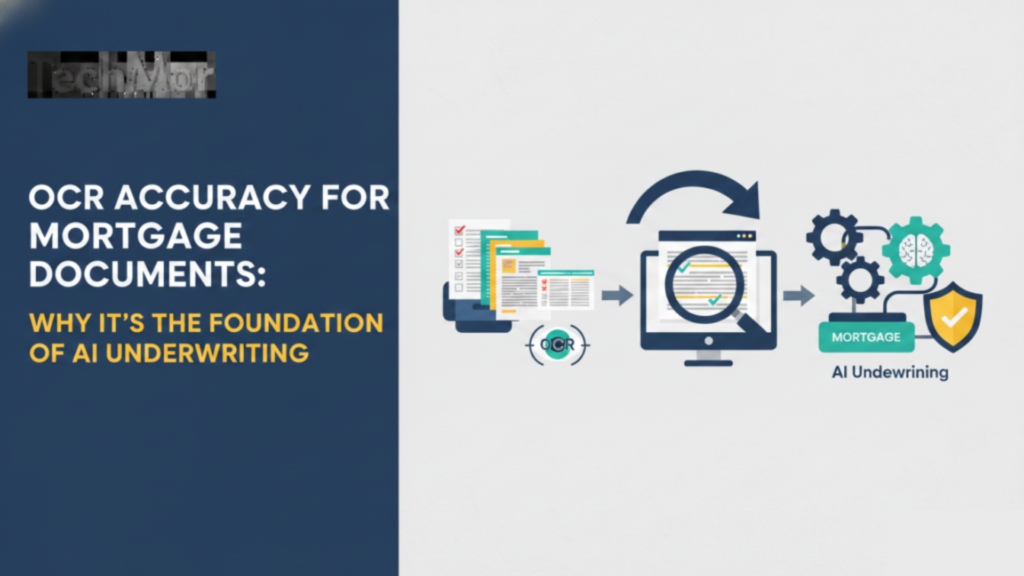

Artificial intelligence in mortgage underwriting depends on one thing above all else: reliable data. Models can evaluate risk, detect anomalies, and automate decisions, but only if the input data is correct.
That’s where OCR accuracy for mortgage documents becomes foundational. Optical Character Recognition (OCR) is not just a preprocessing step. It defines the quality of every downstream decision in an underwriting workflow.
When OCR performs well, automation works as intended. When it doesn’t, errors propagate through the system, affecting calculations, compliance checks, and final loan decisions.
The Data Quality Problem in AI Underwriting
AI underwriting systems operate on structured data. Mortgage documents, however, are unstructured by nature.
Loan files include:
- Pay stubs
- Bank statements
- Tax returns
- Credit documents
- Disclosures
Each document contains critical data points that must be extracted and standardized. If extraction fails, the system processes incorrect inputs.
This is the “garbage in, garbage out” problem. Without high OCR accuracy for mortgage documents, even the most advanced AI native underwriting platform produces unreliable outcomes.
Why OCR Is the First Layer of AI Mortgage Systems
OCR acts as the bridge between raw documents and structured data.
What OCR does:
- Converts scanned or digital documents into machine-readable text
- Extracts key data fields (income, assets, liabilities)
- Structures information for downstream processing
Every step in underwriting, risk assessment, compliance validation, and decisioning, depends on this structured output.
High OCR accuracy for mortgage documents ensures that extracted data reflects the original source. Low accuracy introduces discrepancies that require manual correction.
The Complexity of Mortgage Document OCR
Mortgage files are not uniform. They present a wide range of challenges for OCR systems.
1. Hundreds of Document Types per Loan
A single loan file can contain dozens of document types, each with different layouts and formats.
Examples include:
- IRS forms
- Employer-generated pay stubs
- Bank statements from different institutions
Each format requires different extraction logic. Maintaining OCR accuracy for mortgage documents across this variability is a technical challenge.
2. Handwritten Entries
Many documents include:
- Handwritten notes
- Signatures
- Corrections
Handwriting introduces ambiguity that standard OCR struggles to interpret accurately.
3. Low-Quality Scans
Documents are often:
- Scanned at low resolution
- Photographed with mobile devices
- Cropped or skewed
These factors reduce text clarity and increase extraction errors.
4. Legacy Formats
Older documents may use:
- Non-standard layouts
- Obsolete formatting
- Inconsistent field placement
OCR systems must adapt to both modern and legacy inputs.
Given these challenges, achieving consistent OCR accuracy for mortgage documents requires more than basic text recognition. It requires context-aware extraction and validation.
How OCR Errors Cascade Through Underwriting
Errors at the OCR stage do not stay isolated. They propagate through the entire underwriting process.
1. Income Miscalculation
If OCR misreads:
- Income figures
- Pay frequency
- Employer details
The system calculates incorrect qualifying income.
2. Compliance Failures
Incorrect data can lead to:
- Misapplied guidelines
- Incomplete disclosures
- Regulatory violations
This increases risk during audits and investor reviews.
3. Additional Underwriting Conditions
When discrepancies appear, underwriters add conditions:
- Requesting additional documentation
- Re-verifying data
This slows processing and increases operational cost.
4. Reduced Confidence in Automation
Frequent OCR errors force teams to:
- Double-check outputs
- Revert to manual processes
This limits the effectiveness of machine learning for mortgage lenders.
Maintaining high OCR accuracy for mortgage documents prevents these cascading effects and supports consistent automation.
Document Indexing and Reindexing
Once data is extracted, documents must be organized and classified correctly.
Automatic Document Indexing
Modern systems:
- Identify document types
- Assign metadata
- Organize files within the loan structure
This reduces manual sorting and improves accessibility.
Automated Document Reindexing for Mortgages
When documents are:
- Misclassified
- Uploaded incorrectly
- Missing metadata
Systems can apply automated document reindexing for mortgages to correct organization.
Impact on Underwriting
Proper indexing:
- Reduces time spent locating documents
- Improves workflow efficiency
- Supports faster review cycles
Accurate classification complements OCR accuracy for mortgage documents by ensuring data is both correct and accessible.
Data Verification: OCR to Source Reconciliation
Extraction alone is not enough. Data must be verified against source systems.
OCR-to-LOS Comparison
Systems compare extracted data with:
- Loan Origination System (LOS) entries
- Application data
- Third-party verifications
High-Volume Data Checks
Advanced platforms can perform:
- 100,000+ data point comparisons per loan
This level of validation helps improve mortgage loan data accuracy across the file.
Identifying Variances
When discrepancies occur, systems:
- Flag inconsistencies
- Generate exception reports
- Trigger review workflows
Outcome
This process ensures that:
- Extracted data matches source documents
- LOS data reflects actual borrower information
High OCR accuracy for mortgage documents reduces the number of variances and improves overall efficiency.
MISMO 3.4 Compliance and Data Standards
Mortgage data must align with industry standards for investor delivery.
What MISMO 3.4 Provides
MISMO defines standardized data formats for mortgage transactions.
Why Standardization Matters
Structured output ensures:
- Consistent data interpretation
- Compatibility with investor systems
- Streamlined loan delivery
Role of OCR in Compliance
OCR systems must:
- Map extracted data to standardized fields
- Align with MISMO 3.4 compliant underwriting software requirements
Impact on Delivery
Accurate, standardized data:
- Reduces investor exceptions
- Improves loan sale timelines
- Supports regulatory compliance
Maintaining OCR accuracy for mortgage documents is essential for meeting these standards.
The Role of AI-Native Platforms
Traditional systems treat OCR as a separate function. Modern platforms integrate OCR directly into the underwriting workflow.
Providers like TechMor Services build systems where:
- OCR feeds directly into decision engines
- Data validation occurs in real time
- Document indexing and verification are integrated
Key capabilities:
- End-to-End Data Flow
From document ingestion to decision output. - Integrated Validation
Combining OCR with verification logic to improve mortgage loan data accuracy. - Scalable Processing
Supporting high loan volumes without manual bottlenecks. - Continuous Learning
Applying machine learning for mortgage lenders to improve extraction over time.
This integrated approach ensures that OCR accuracy for mortgage documents is maintained throughout the workflow.
Operational Benefits of High OCR Accuracy
Improving OCR performance delivers measurable outcomes.
1. Faster Underwriting
Accurate data reduces manual review and speeds decisioning.
2. Lower Operational Costs
Fewer corrections reduce labor requirements.
3. Improved Compliance
Consistent data supports regulatory and investor requirements.
4. Reduced Conditions
Fewer discrepancies lead to fewer underwriting conditions.
5. Better Scalability
Automation handles increased volume without proportional staffing increases.
These benefits reinforce the importance of OCR accuracy for mortgage documents as a core system capability.
Practical Comparison
Low OCR Accuracy:
- Frequent data errors
- Increased manual intervention
- Slower processing times
- Higher compliance risk
High OCR Accuracy:
- Reliable data extraction
- Reduced manual review
- Faster underwriting cycles
- Improved loan quality
The difference is not incremental. It defines whether automation delivers value.
Final Thoughts
AI underwriting depends on structured, reliable data. OCR is the first step in creating that data.
Without high OCR accuracy for mortgage documents, downstream systems operate on flawed inputs. With it, automation becomes consistent, scalable, and reliable.
For lenders adopting advanced systems, OCR is not a supporting feature. It is the foundation.
Looking to Improve OCR Accuracy and Underwriting Performance?
If you’re evaluating solutions that combine OCR, validation, and underwriting automation, explore platforms built for integrated workflows.
Learn more from TechMor Services: From AI native underwriting platform capabilities to MISMO 3.4 compliant underwriting software, a structured approach to data extraction and validation helps improve accuracy, reduce risk, and support scalable mortgage operations.
